

Dudley, JRR; Shears, A; Yan, G; Heath, PT; Ladhani, SN; Ribeiro, S; Fidler, K
(2025)
Herpes simplex virus disease in infants younger than 90 days: a British Paediatric Surveillance Unit study.
Archives of Disease in Childhood.
ISSN 0003-9888
https://doi.org/10.1136/archdischild-2025-329176
SGUL Authors: Heath, Paul Trafford Ladhani, Shamez Nizarali
![[img]](https://openaccess.sgul.ac.uk/style/images/fileicons/application_vnd.openxmlformats-officedocument.wordprocessingml.document.png) |
Microsoft Word (.docx)
Accepted Version
Available under License ["licenses_description_publisher" not defined]. Download (91kB) |
|
![[img]](https://openaccess.sgul.ac.uk/id/eprint/117991/5/Figure%201%20.png)
|
Image (PNG) (Figure 1)
Accepted Version
Available under License ["licenses_description_publisher" not defined]. Download (121kB) | Preview |
|
![[img]](https://openaccess.sgul.ac.uk/id/eprint/117991/6/Figure2.jpg)
|
Image (JPEG) (Figure 2)
Accepted Version
Available under License ["licenses_description_publisher" not defined]. Download (304kB) | Preview |
|
![[img]](https://openaccess.sgul.ac.uk/id/eprint/117991/7/Figure%203.jpg)
|
Image (JPEG) (Figure 3)
Accepted Version
Available under License ["licenses_description_publisher" not defined]. Download (394kB) | Preview |
|
|
Microsoft Word (.docx) (Supplemental Tables)
Supporting information
Download (23kB) |
Abstract
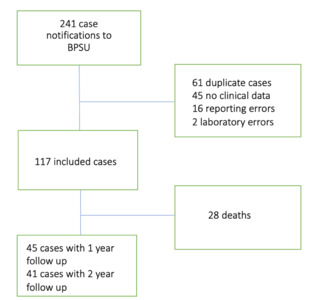
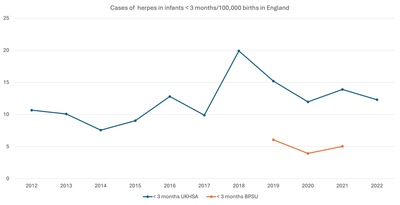
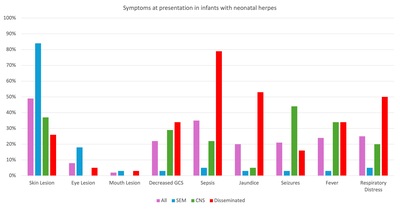
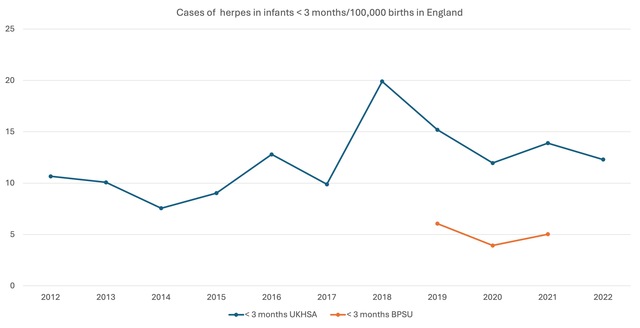
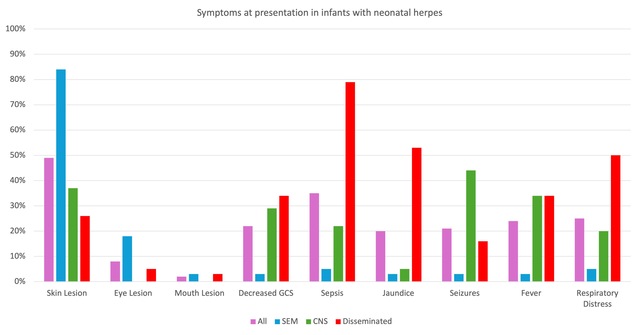
Objective Estimate the incidence of herpes simplex virus (HSV) infections in infants under 90 days in the UK and Ireland and describe clinical presentation and outcomes. Design Prospective population-based national surveillance study of infants <90 days with HSV infection, using British Paediatric Surveillance Unit (BPSU) methodology (August 2019–February 2022). Results 117 infants with confirmed HSV infection were identified (6.0 cases/100 000 live births (95% CI 4.9, 7.2)). One-third (34.5%) of infants were premature (<37 weeks) and the majority (81.4%) were born to women without a known/disclosed history of genital herpes. Neonatal HSV was classified as disseminated (32.5%), central nervous system (CNS) (35%) or skin, eye, mouth (SEM) (32.5%) disease. Median age at symptom onset was 8 days (IQR 5–13) in all infants (D8 SEM, D14 CNS, D6 disseminated). 56.7% of infants commenced aciclovir >24 hours after symptom onset. Infants with disseminated infections presented with non-specific signs of sepsis: 65.8% were afebrile and 73.7% had no SEM lesions. Median C reactive protein at presentation was 4 mg/L (IQR 1–14). Overall mortality was 23.9%, rising to 65.8% among infants with disseminated disease. Of the 41 infants with follow-up data at 24 months, 29.3% had neurodevelopmental impairment (11.8% SEM, 45% CNS, 25% disseminated). Conclusions Infants with neonatal HSV can present without fever, SEM lesions or elevated infection markers; treatment delay is subsequently common. Outcomes remain poor with high case-fatality rates and long-term morbidity. Clinicians should have a low threshold for empirically testing for and treating herpes in unwell neonates.
| Item Type: | Article | |||||||||
|---|---|---|---|---|---|---|---|---|---|---|
| Additional Information: | This article has been accepted for publication in Archives of Disease in Childhood, 2025 following peer review, and the Version of Record can be accessed online at https://doi.org/10.1136/archdischild-2025-329176. © Author(s) (or their employer(s)) 2025. | |||||||||
| Keywords: | infectious disease medicine, neonatology, paediatrics | |||||||||
| SGUL Research Institute / Research Centre: | Academic Structure > Infection and Immunity Research Institute (INII) | |||||||||
| Journal or Publication Title: | Archives of Disease in Childhood | |||||||||
| ISSN: | 0003-9888 | |||||||||
| Language: | en | |||||||||
| Media of Output: | Print-Electronic | |||||||||
| Related URLs: | ||||||||||
| Publisher License: | Publisher's own licence | |||||||||
| Projects: |
|
|||||||||
| PubMed ID: | 40897403 | |||||||||
| Dates: |
|
|||||||||
 |
Go to PubMed abstract | |||||||||
| URI: | https://openaccess.sgul.ac.uk/id/eprint/117991 | |||||||||
| Publisher's version: | https://doi.org/10.1136/archdischild-2025-329176 |
Statistics
Actions (login required)
 |
Edit Item |