

Androulakis, E;
Georgiopoulos, G;
Azzu, A;
Surkova, E;
Bakula, A;
Papagkikas, P;
Briasoulis, A;
De Silva, R;
Kellman, P;
Pennell, D;
et al.
Androulakis, E; Georgiopoulos, G; Azzu, A; Surkova, E; Bakula, A; Papagkikas, P; Briasoulis, A; De Silva, R; Kellman, P; Pennell, D; Alpendurada, F
(2024)
Reduced response to regadenoson with increased weight: An artificial intelligence–based quantitative myocardial perfusion study.
Journal of Cardiovascular Magnetic Resonance, 26 (2).
p. 101066.
ISSN 1097-6647
https://doi.org/10.1016/j.jocmr.2024.101066
SGUL Authors: Androulakis, Emmanouil
![[img]](https://openaccess.sgul.ac.uk/style/images/fileicons/application_pdf.png) |
PDF
Published Version
Available under License Creative Commons Attribution. Download (1MB) |
|
![[img]](https://openaccess.sgul.ac.uk/style/images/fileicons/application_vnd.openxmlformats-officedocument.wordprocessingml.document.png) |
Microsoft Word (.docx) (Supplementary material)
Supporting information
Download (15kB) |
|
![[img]](https://openaccess.sgul.ac.uk/id/eprint/118542/3/1-s2.0-S1097664724010937-mmc2_lrg.jpg)
|
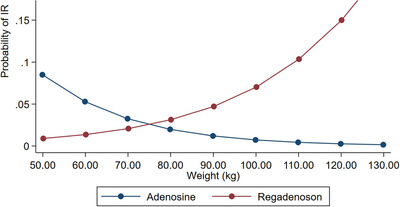
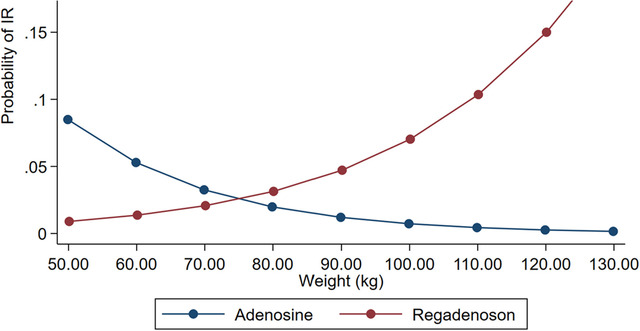
Image (JPEG) (Supplementary Figure. Differential association of weight with the probability of inadequate stress response conditional on adenosine vs regadenoson use in 308 matched patients.)
Supporting information
Download (133kB) | Preview |
Abstract
BACKGROUND: There is conflicting evidence regarding the response to a fixed dose of regadenoson in patients with high body weight. The aim of this study was to evaluate the effectiveness of regadenoson in patients with varying body weights using novel quantitative cardiovascular magnetic resonance (CMR) perfusion parameters in addition to standard clinical markers. METHODS: Consecutive patients with typical angina and/or risk factors for coronary artery disease (N = 217) underwent regadenoson stress CMR perfusion imaging using a dual-sequence quantitative protocol with perfusion parameters generated from an artificial intelligence (AI)-based algorithm. CMR was performed on 1.5T scanners using a standard 0.4 mg injection of regadenoson. A cohort of consecutive patients undergoing adenosine stress perfusion (N = 218) was used as a control group. RESULTS: An inverse association of myocardial perfusion reserve and weight (mean decrease -0.05 per 10 kg increase, 95% confidence interval [CI] -0.009/-0.0001, P = 0.045) was noted in the regadenoson group but not in patients stressed with adenosine (P = 0.77). Adjusted logistic regression analysis revealed a 10 kg increase resulted in 36% increased odds for inadequate stress response (odds ratio [OR] = 1.36, 95% CI 1.10-1.69, P = 0.005). Moreover, a significant interaction (OR = 1.09, 95% CI 1.02-1.16, P = 0.012) between stressor type (regadenoson vs adenosine) and weight was noted. This was also confirmed in the propensity-matched subgroup (P = 0.024) and was not attenuated after adjustment (P = 0.041). Body surface area (BSA) (P = 0.006) but not body mass index (P = 0.055) was differentially associated with inadequate response conditional to the stressor used, and this association remained significant after adjustment for confounders (P = 0.025). Patients in the highest quartile of weight (>93 kg) or BSA (>2.06 m2) had substantially increased odds for inadequate response with regadenoson (OR = 8.19, 95% CI 2.04-32.97, P = 0.003 for increased weight and OR = 7.75, 95% CI 1.93-31.13, P = 0.004 for increased BSA). Both weight and BSA had excellent discriminative ability for inadequate regadenoson response (receiver operating characteristic area under curves 0.84 and 0.83, respectively). CONCLUSION: Using quantitative perfusion CMR in patients undergoing pharmacological stress with regadenoson, we found an inverse relationship between patient weight and both clinical response and myocardial perfusion parameters. A fixed-dose bolus approach may not be adequate to induce maximal hyperemia in patients with increased weight. Weight-adjusted stressors, such as adenosine, may be considered instead in patients with body weight >93 kg and BSA >2.06 m2.
| Item Type: | Article | ||||||||
|---|---|---|---|---|---|---|---|---|---|
| Additional Information: | © 2024 The Author(s). Published by Elsevier Inc. on behalf of Society for Cardiovascular Magnetic Resonance. This is an open access article under the CC BY license (http://creativecommons.org/licenses/by/4.0/). | ||||||||
| Keywords: | Adenosine, Cardiovascular magnetic resonance, Quantitative perfusion, Regadenoson, Weight, Humans, Purines, Pyrazoles, Myocardial Perfusion Imaging, Male, Female, Middle Aged, Artificial Intelligence, Predictive Value of Tests, Aged, Coronary Circulation, Coronary Artery Disease, Algorithms, Adenosine, Vasodilator Agents, Adenosine A2 Receptor Agonists, Body Weight, Logistic Models, Case-Control Studies, Image Interpretation, Computer-Assisted, Obesity, Risk Factors | ||||||||
| SGUL Research Institute / Research Centre: | Academic Structure > Cardiovascular & Genomics Research Institute Academic Structure > Cardiovascular & Genomics Research Institute > Clinical Cardiology |
||||||||
| Journal or Publication Title: | Journal of Cardiovascular Magnetic Resonance | ||||||||
| ISSN: | 1097-6647 | ||||||||
| Language: | en | ||||||||
| Media of Output: | Print-Electronic | ||||||||
| Related URLs: | |||||||||
| Publisher License: | Creative Commons: Attribution 4.0 | ||||||||
| Dates: |
|
||||||||
| URI: | https://openaccess.sgul.ac.uk/id/eprint/118542 | ||||||||
| Publisher's version: | https://doi.org/10.1016/j.jocmr.2024.101066 |
Statistics
Actions (login required)
 |
Edit Item |