

Howe, FA;
Koushesh, S;
Blundell, A;
Law, A;
Harrison, A;
Ejindu, V;
Taylor-Kuti, S;
Niakan, A;
Sheppard, M;
Ljuhar, R;
et al.
Howe, FA; Koushesh, S; Blundell, A; Law, A; Harrison, A; Ejindu, V; Taylor-Kuti, S; Niakan, A; Sheppard, M; Ljuhar, R; Sofat, N
(2026)
Thrombospondin-4 correlates with MRI measures of structural damage and pain sensitisation: a new biomarker in knee osteoarthritis.
Knee, 59.
p. 104305.
ISSN 1873-5800
https://doi.org/10.1016/j.knee.2025.104305
SGUL Authors: Sofat, Nidhi
![[img]](https://openaccess.sgul.ac.uk/style/images/fileicons/application_pdf.png) |
PDF
Published Version
Available under License Creative Commons Attribution. Download (1MB) |
|
![[img]](https://openaccess.sgul.ac.uk/id/eprint/118114/13/1-s2.0-S0968016025003278-mmc1_lrg.jpg)
|
Image (JPEG) (Supplementary Figure 1)
Supporting information
Download (566kB) | Preview |
|
![[img]](https://openaccess.sgul.ac.uk/id/eprint/118114/14/1-s2.0-S0968016025003278-mmc2_lrg.jpg)
|
Image (JPEG) (Supplementary Figure 2)
Supporting information
Download (187kB) | Preview |
|
![[img]](https://openaccess.sgul.ac.uk/style/images/fileicons/application_vnd.openxmlformats-officedocument.wordprocessingml.document.png) |
Microsoft Word (.docx) (Supplementary Data 3)
Supporting information
Download (30kB) |
|
|
PDF
Accepted Version
Available under License Creative Commons Attribution. Download (2MB) |
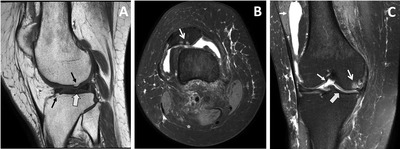
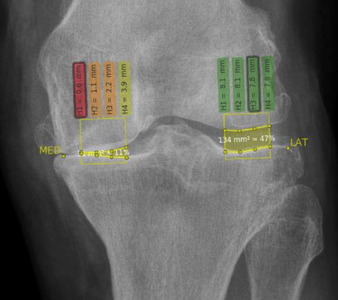
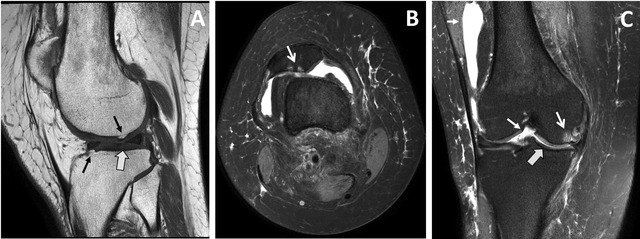
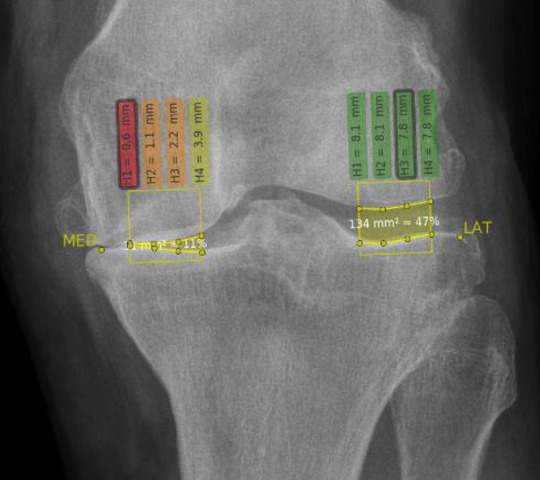
Abstract
Background We hypothesised thrombospondin-4 (TSP-4), a molecule mediating pain sensitisation in peripheral nerve injury, is associated with pain sensitisation in OA. Methods A cross-sectional study of clinical, imaging and fluid biomarkers from knee OA participants was conducted. TSP-4 was assessed by immunohistochemistry (IHC) for OA tissue samples and by ELISA in serum samples. Type II collagen degradation products (CTX-II), linked to OA structural damage, was determined from urine samples. A general linear model (GLM) was used to: a) investigate how patient-reported WOMAC (Western Ontario and McMaster Universities OsteoArthritis Index) pain/stiffness subscales and pain sensitisation measured by painDETECT, related to the Hospital Anxiety and Depression Scale (HADS), structural damage quantified from MRI and X-rays, CTX-II and TSP-4; b) how TSP-4 related to structural damage. We used linear discriminant analysis (LDA) to determine a classifier for pain-sensitisation from clinical and wet-biomarkers. Results TSP-4 was expressed in cartilage, bone marrow lesion (BML) and synovial tissue from OA samples. Upregulated TSP-4 protein was observed in cartilage, synovial tissue and BMLs in a perivascular distribution and in fibrotic tissue. Serum TSP-4 was significantly higher (p = 0.001) in those with pain sensitisation (painDETECT level ≥19) compared with non-sensitised participants. Serum TSP-4 was significantly increased with Hoffa’s synovitis (p < 0.001) and number of BMLs (p < 0.001 to p < 0.05). LDA provided classification accuracy of 80 % for pain sensitisation using TSP-4, CTX-II and HADS, supporting the biopsychosocial model of pain in OA. Conclusion Our data suggests TSP-4 is associated with pain sensitisation in OA and is a biomarker stratifying for pain sensitisation.
| Item Type: | Article | ||||||||||||
|---|---|---|---|---|---|---|---|---|---|---|---|---|---|
| Additional Information: | © 2025 The Author(s). Published by Elsevier B.V. This is an open access article under the CC BY license (http://creativecommons.org/licenses/by/4.0/). | ||||||||||||
| SGUL Research Institute / Research Centre: | Academic Structure > Infection and Immunity Research Institute (INII) | ||||||||||||
| Journal or Publication Title: | Knee | ||||||||||||
| ISSN: | 1873-5800 | ||||||||||||
| Publisher License: | Creative Commons: Attribution 4.0 | ||||||||||||
| Projects: |
|
||||||||||||
| Dates: |
|
||||||||||||
| URI: | https://openaccess.sgul.ac.uk/id/eprint/118114 | ||||||||||||
| Publisher's version: | https://doi.org/10.1016/j.knee.2025.104305 |
Statistics
Actions (login required)
 |
Edit Item |