

Bergman, JEH;
Perraud, A;
Garne, E;
Barisic, I;
Tucker, D;
Ballardini, E;
Bruneau, L;
Cavero‐Carbonell, C;
Cousin, I;
Gatt, M;
et al.
Bergman, JEH; Perraud, A; Garne, E; Barisic, I; Tucker, D; Ballardini, E; Bruneau, L; Cavero‐Carbonell, C; Cousin, I; Gatt, M; Kovacheva, K; Latos‐Bielenska, A; O'Mahony, M; Monier, I; Perthus, I; Pertile, R; Rissmann, A; Rouget, F; Santoro, M; Sichitiu, J; Verellen‐Dumoulin, C; Wertelecki, W; Wellesley, D; Morris, JK
(2025)
Genetic Diagnoses Among Congenital Anomaly Cases in Europe: Data From the EUROCAT Network.
Paediatric and Perinatal Epidemiology.
ISSN 0269-5022
https://doi.org/10.1111/ppe.70099
SGUL Authors: Morris, Joan Katherine
![[img]](https://openaccess.sgul.ac.uk/style/images/fileicons/application_pdf.png) |
PDF
Published Version
Available under License Creative Commons Attribution. Download (634kB) |
|
![[img]](https://openaccess.sgul.ac.uk/id/eprint/118086/2/ppe70099-sup-0001-figures1.png)
|
Image (PNG) (Figure S1)
Supporting information
Download (38kB) | Preview |
|
![[img]](https://openaccess.sgul.ac.uk/style/images/fileicons/application_vnd.openxmlformats-officedocument.wordprocessingml.document.png) |
Microsoft Word (.docx) (Table S1)
Supporting information
Download (27kB) |
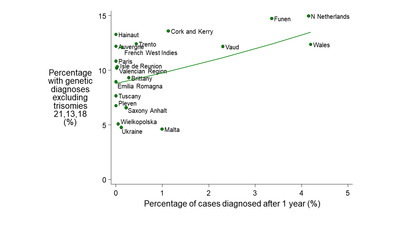
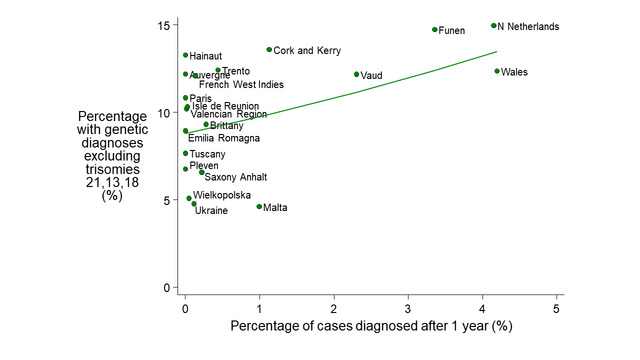
Abstract
Background Surveillance of congenital anomaly prevalence over time can identify new teratogens. Anomalies with a genetic cause are excluded from the monitoring. Objectives We examined temporal changes in the proportion of genetic diagnoses among cases with a congenital anomaly. Methods Data was used from twenty EUROCAT congenital anomaly registries over the birth years 2013 and 2022. All pregnancy outcomes were included. Multilevel binomial regression models were fitted to estimate the annual change in the proportion of genetic diagnoses of all anomalies by registry. Results were additionally reported, excluding cases with trisomy 13, 18, or 21. Results Overall, 20% of the 100,099 cases in the study had a genetic diagnosis, and this proportion increased annually by 1.4% (95% CI, 0.8%–1.9%); an absolute increase of approximately 3% from 2013 to 2022. After excluding the trisomies, the overall proportion was 10% with an annual increase of 1.2% (95% CI 0.4%–2.0%). There was considerable variation in the proportion of genetic cases per registry. An increasing proportion of genetic diagnoses was found for five congenital anomaly groups, after excluding the trisomies. We hypothesise that the increase in genetic diagnoses is due to increased access to clinical genetic services, more extensive genetic testing, and the identification of new genes as causes of congenital anomalies. Conclusions The modest increase in genetic diagnoses among cases with a congenital anomaly is not expected to have a large impact on the surveillance of the non-genetic anomalies in the EUROCAT network. EUROCAT will continue to monitor the proportion of genetic diagnoses every five years.
| Item Type: | Article | |||||||||
|---|---|---|---|---|---|---|---|---|---|---|
| Additional Information: | © 2025 The Author(s). Paediatric and Perinatal Epidemiology published by John Wiley & Sons Ltd. This is an open access article under the terms of the Creative Commons Attribution License, which permits use, distribution and reproduction in any medium, provided the original work is properly cited. | |||||||||
| Keywords: | birth defects, heart defects, neural tube defects, orofacial clefts, syndrome, trends | |||||||||
| SGUL Research Institute / Research Centre: | Academic Structure > Population Health Research Institute (INPH) | |||||||||
| Journal or Publication Title: | Paediatric and Perinatal Epidemiology | |||||||||
| ISSN: | 0269-5022 | |||||||||
| Language: | en | |||||||||
| Media of Output: | Print-Electronic | |||||||||
| Related URLs: | ||||||||||
| Publisher License: | Creative Commons: Attribution 4.0 | |||||||||
| Projects: |
|
|||||||||
| PubMed ID: | 41277385 | |||||||||
| Dates: |
|
|||||||||
 |
Go to PubMed abstract | |||||||||
| URI: | https://openaccess.sgul.ac.uk/id/eprint/118086 | |||||||||
| Publisher's version: | https://doi.org/10.1111/ppe.70099 |
Statistics
Actions (login required)
 |
Edit Item |