

Chia-Yin Lin, R;
Lau, K;
Mackey, K;
Matthews, NR;
Selvamani, M;
Morais, B;
Bouaddi, O;
Kim, C;
Iwamoto, A;
Fujita, M;
et al.
Chia-Yin Lin, R; Lau, K; Mackey, K; Matthews, NR; Selvamani, M; Morais, B; Bouaddi, O; Kim, C; Iwamoto, A; Fujita, M; Trummer, U; Dang, TN; Kamenshchikova, A; Zimmerman, C; Hargreaves, S
(2025)
Adverse health outcomes among migrant workers and transnational families in the Asia–Pacific: a systematic review and meta-analysis.
The Lancet Regional Health - Western Pacific, 64.
p. 101720.
ISSN 2666-6065
https://doi.org/10.1016/j.lanwpc.2025.101720
SGUL Authors: Hargreaves, Sally
![[img]](https://openaccess.sgul.ac.uk/style/images/fileicons/application_pdf.png) |
PDF
Published Version
Available under License Creative Commons Attribution. Download (2MB) |
|
![[img]](https://openaccess.sgul.ac.uk/style/images/fileicons/application_vnd.openxmlformats-officedocument.wordprocessingml.document.png) |
Microsoft Word (.docx) (Appendix 1-3)
Supporting information
Download (35kB) |
|
![[img]](https://openaccess.sgul.ac.uk/id/eprint/118029/2/1-s2.0-S2666606525002597-figs1_lrg.jpg)
|
Image (JPEG) (Appendix 4)
Supporting information
Download (353kB) | Preview |
|
![[img]](https://openaccess.sgul.ac.uk/id/eprint/118029/3/1-s2.0-S2666606525002597-figs2_lrg.jpg)
|
Image (JPEG) (Appendix 5)
Supporting information
Download (204kB) | Preview |
|
![[img]](https://openaccess.sgul.ac.uk/id/eprint/118029/4/1-s2.0-S2666606525002597-figs3_lrg.jpg)
|
Image (JPEG) (Appendix 6)
Supporting information
Download (153kB) | Preview |
|
![[img]](https://openaccess.sgul.ac.uk/id/eprint/118029/5/1-s2.0-S2666606525002597-figs4_lrg.jpg)
|
Image (JPEG) (Appendix 7)
Supporting information
Download (178kB) | Preview |






Abstract
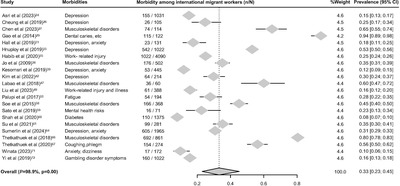
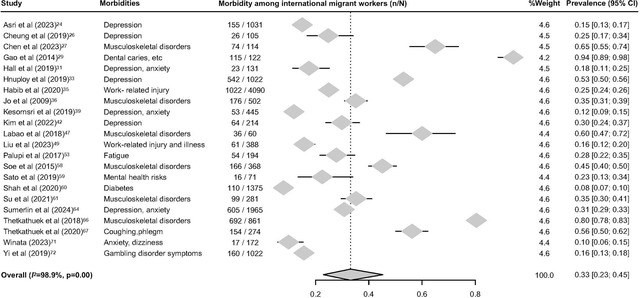
Background Labour migration is a growing global phenomenon, with migrant workers known to be more likely to experience exploitative and precarious work, impacting their health. Despite hosting over 27 million international migrant workers, the Asia–Pacific region remains underrepresented in global health evidence, limiting the development of targeted, region-specific health interventions. This study aims to investigate the health status of migrant workers and their transnational families in the Asia–Pacific region. Methods We conducted a systematic review and meta-analysis (PROSPERO: CRD42024528561) of primary studies published between Jan 1, 2013, and April 1, 2024. We searched MEDLINE, Embase, PsycINFO, and Ovid Global Health for studies reporting work-related morbidity and mortality among international migrant workers and their transnational families in the Asia–Pacific region. A narrative synthesis identified occupational risks; a meta-analysis estimated pooled prevalence of morbidity among migrant workers and relative risks compared to local workers. Findings Of 2877 studies identified, 54 met inclusion criteria, including 38 eligible for meta-analysis, encompassing 86,620 individuals across 17 Asia–Pacific countries. Among migrant workers (n = 64,172), 88.4% experienced occupational injuries and illnesses including work-related injuries, pesticide poisoning symptoms and respiratory diseases (n = 45,661), with 75% of migrant workers in this large dataset working in high-risk sectors such as manufacturing, construction, and services (including drivers and restaurant workers). 3.8% reported symptoms of mental health disorders such as anxiety and depression (n = 1975), and 3.8% had musculoskeletal disorders (n = 1973). The pooled prevalence of at least one work-related morbidity was 37% (95% CI: 27–47; I2 = 99.0%), with a pooled relative risk of 1.29 (95% CI: 1.10–1.52; I2 = 47.4%) compared with local workers. Among transnational families left behind in the migrant worker's country of origin (n = 22,448), 50.1% reported mental health issues (n = 1520), and 31.4% experienced undernutrition (n = 954). Key contributing factors to poor health outcomes of migrant workers included long working hours, workplace hazards, precarious working conditions, and healthcare access barriers. Interpretation Migrant workers in the Asia–Pacific face substantial risks of a wide range of occupational injuries and illnesses. Although some studies support the “healthy migrant effect,” this advantage clearly diminishes over time due to cumulative exposure to occupational and structural stressors. Strengthening occupational safety, regulating working hours, and improving healthcare access, are urgent priorities for countries hosting large migrant worker populations and employers of migrant workers. Funding Ministry of Education, Taiwan; Wellcome Trust (318501/Z/24/Z and 335954/Z/25/Z); UK Medical Research Council (MR/W006677/1); UK National Health Institute for Health and Care Research (NIHR209895); the ‘la Caixa' Foundation (LCF/PR/SP21/52930003).
| Item Type: | Article | ||||||||||||||||||||||||
|---|---|---|---|---|---|---|---|---|---|---|---|---|---|---|---|---|---|---|---|---|---|---|---|---|---|
| Additional Information: | Correction available at: https://doi.org/10.1016/j.lanwpc.2025.101774 Copyright © 2025 The Author(s). Published by Elsevier Ltd. This is an open access article under the CC BY license (http://creativecommons.org/licenses/by/4.0/). | ||||||||||||||||||||||||
| SGUL Research Institute / Research Centre: | Academic Structure > Infection and Immunity Research Institute (INII) | ||||||||||||||||||||||||
| Journal or Publication Title: | The Lancet Regional Health - Western Pacific | ||||||||||||||||||||||||
| ISSN: | 2666-6065 | ||||||||||||||||||||||||
| Language: | en | ||||||||||||||||||||||||
| Publisher License: | Creative Commons: Attribution 4.0 | ||||||||||||||||||||||||
| Projects: |
|
||||||||||||||||||||||||
| Dates: |
|
||||||||||||||||||||||||
| URI: | https://openaccess.sgul.ac.uk/id/eprint/118029 | ||||||||||||||||||||||||
| Publisher's version: | https://doi.org/10.1016/j.lanwpc.2025.101720 |
Statistics
Actions (login required)
 |
Edit Item |